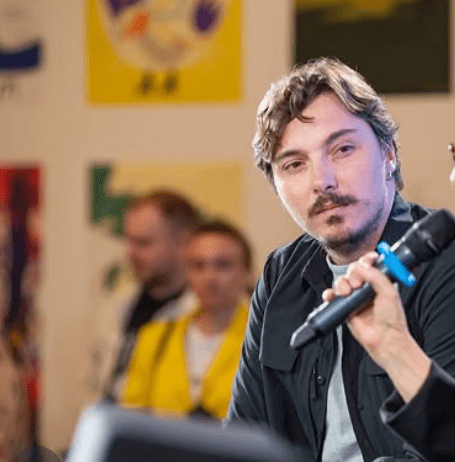
Sun. 14 June, 2026 – Amid tensions between Ukrainian-Polish relations, Ukrainian author and soldier Andriy Lyubka shed light on the Ukrainian perspective during war at the 2026 Book Arsenal festival in Kyiv, Ukraine.
I attended this festival and filmed some of the speeches to share with a broader audience.
Recently I collaborated with Iryna Rymar, Philology student at UCU:, who translated the following statement made by Lyubka into English:
“The first building hit by a Russian drone is burning and this is an event that changes many things. Certainly, when a country is going through such difficult periods, why do we have no elections? Why is there no political activity in Ukraine? Because we understand that any political activity at this time would be self-destructive. It could plunge us into an internal vacuum and make us weaker. Poland, like all other countries, goes through electoral cycles, and in order to win voter sympathy, parties sharpen their statements, their positions, and so on as much as possible. We observe this very clearly in Ukraine. We follow all elections across European countries: how we lived through the elections in Moldova, wondering whether we would now have a Russian ally there; how we rejoiced when the government changed in Hungary; to what extent both Polish ruling parties — PiS (Law and Justice) and The Civic Platform — are pro-Ukrainian in their core and in their actions. At the moment, there is consensus there. There is a certain difference in how they express it, but on the whole both parties have supported us. And yet, when Tusk came to power and became Prime Minister, we said: “this is even a little better.” Every electoral cycle shifts public opinion and, unfortunately, affects us. You are still a media figure, you still explain many things to the media in the traditional way, but it seems to me that this has largely receded into the past, at least for us. Social media has determined a great deal, a very great deal. “Excuse me, but that is also the media.” Well… in that sense, yes, but not that is to say, it is no longer a matter of whether a journalist picks up a story or not. This is a formation that is horizontal: everyone has become a speaker, everyone has a smartphone, everyone can post their deeply authoritative opinion on any topic, everyone is in a bad mood because something went wrong, they are angry, and they can pour that anger in whatever direction they choose, or wherever there happens to be some noise. Social media will always amplify the negative. When we say that a Ukrainian teenager was beaten in Poland it is a devastating fact, and it becomes news in Poland and news in Ukraine. But nobody thinks about the fact that at the very same moment, two million Ukrainians living in Poland quietly made their way to work, to their homes, and interacted with Poles. There were no such problems. In other words, a single incident is inflated into a major issue, while the two million go unmentioned because this new media landscape is oriented towards the negative, oriented towards provoking emotion, and positive, uplifting emotions do not generate arguments, do not drive engagement, cannot be monetized, cannot be exploited for political gain or leveraged for a party’s benefit. And so we find ourselves in rather precarious times. But let me repeat: there was absolutely broad consensus in support of Ukraine, and there is an enormous social and human base in Poland. People who support Ukraine, who may politically condemn or reject certain things, including, for instance, the question of the Ukrainian Insurgent Army (UPA), but who at the same time say: “we support Ukrainians, we sympathize with them, we understand that this is a threat to us as well.” In other words, this is not quite a black-and-white process. What matters is how we navigate it, and how we look at it — not just today for today’s sake, but in the spirit of what Krzysztof speaks about, what Jerzy Giedroyć wrote and argued. To what extent will we project our work beyond this short political or media cycle. Any bombshell lasts three days, and right now everyone will be talking about the White Eagle (I suppose he meant the Order of the White Eagle) . Yet the Poles did not notice that back in February of this year, the first military unit to receive a military designation associated with the UPA, the 190th Training Center for Unmanned Systems of the Armed Forces of Ukraine, was named after UPA General Vasyl Kuk. Nobody talked about it, because the name “General Kuk” was used, not “General of the UPA.” This time, that trigger word was uttered, and it immediately hit the fan. But all of this is noise, noise that vanishes quickly. If we want to speak of lasting outcomes and the building of stable relations, we need to…”
Watch video here:
####
-Alexandra Zakhvatayev
Kyiv Free Press


Leave a Reply